
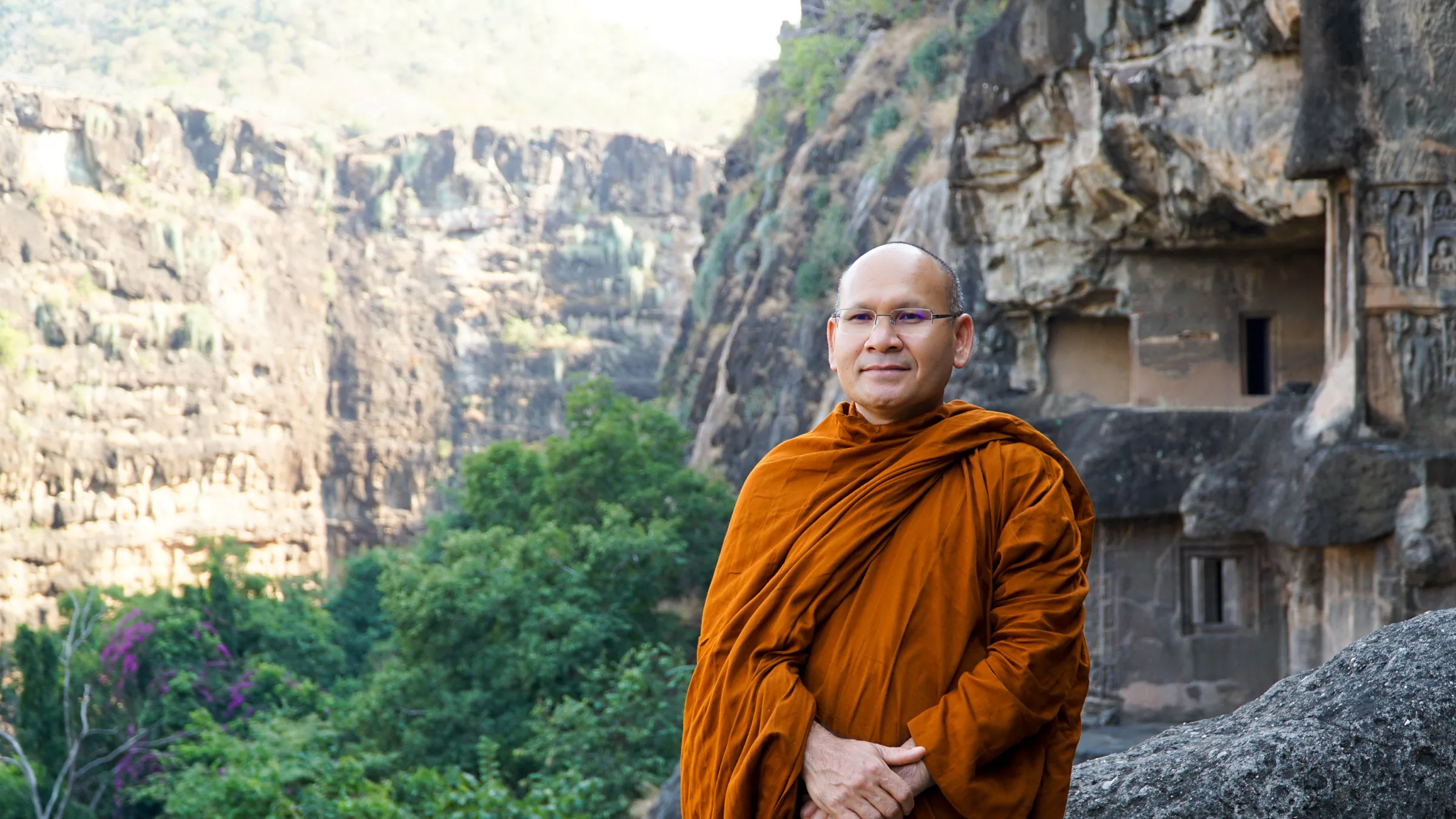
“Phra Ajahn” — widely known and revered under the name Phra Ajahn Prasert Thanangkaro, vipassanā teacher of the Vipassana Mental Development Center — was appointed to the ecclesiastical rank of Phra Khru Winaithon Prasert Thanangkaro on 27 August 2024.
On Sunday 7 December 2025, the Council of Mahachulalongkornrajavidyalaya University, recognising the great contribution he has made in devoting body and mind to spreading the teaching of the Buddha along the path of the four foundations of mindfulness — to monks, novices, and practitioners seeking the complete end of suffering, with unstinting effort and wholehearted resolve — resolved to confer on him the honorary degree of Doctor of Buddhist Studies in Vipassanā Meditation.
Looking back along the path of Phra Ajahn Prasert Thanangkaro’s search for the truth in monastic life: the search for the highest Dhamma in Buddhism and the penetration of the Abhidhamma — the ultimate reality (paramattha) and the supreme Dhamma — is something reached and seen clearly through actual practice, not through one’s own speculation.
Back in 1993 in Trang province, Than Mae Kru Narawan, founder of the Vipassana Mental Development Center and a student of the Great Teacher (Ven. Dr. Bhaddanta Āsabha Mahāthera, Dhammācariya, Aggamahākammaṭṭhānācariya), told the practitioners under her guidance:
Phra Ajahn Prasert Thanangkaro was born Prasert Chaisuwan on 4 July 1970 in Non Sung sub-district, Khun Han district, Sisaket province, to his father Boon Chaisuwan and his mother Than Chaisuwan. He was the seventh of eight children.
In 1990, upon turning 20, he was ordained at Wat Ban Dan with Phra Khru Phattharakitwithan (since deceased) as his preceptor.
“If a young monk should come to the center, receive him.”— Than Mae Kru Narawan to the practitioners under her guidance, 1993
Taking up the wandering life
Later, in 1993, during his third rains retreat at Wat Ban Dan in Khun Han district, he began to reconsider his life as a monk and his daily routine. After fulfilling invitations to chant blessings and receiving the offerings the laity gave, he would return to the monastery — and the question arose in him: what had he ordained for? He turned it over further: “What do we get? What do the listeners get? This is not the purpose of ordaining at all. If it stays like this, I cannot remain in the robes much longer.”
At that very time a fellow wandering monk invited him to set out on dhutaṅga together. Though he longed to go, he did not dare decide, out of deference to the abbot, Phra Khru Sophonpunyapiwat — fearing that if he left, no one would be there to share the abbot’s burden, and that it would be ingratitude towards his teacher. Yet another part of him longed to go.
All that night he did nothing but turn it over again and again — should he go or not — asking and answering himself right through until he had not slept at all. By dawn he had decided, and packed only what was needed for wandering, answering his own question: this journey was not for idle travel; but if he stayed on, he would gain nothing of what he sought in the monastic life.
He then asked leave of Phra Khru Sophonpunyapiwat, saying he was going travelling, without telling him for how many days. From the day he set out on that journey, he never returned to spend a rains retreat at Wat Ban Dan again.
The main reason he so longed to wander was that he wanted to know what the life of a wandering monk was really like, and why people held such faith in them. But the most important thing he truly wanted to find an answer to was this: what is the wandering life aimed at seeking?
In the early period he chose vegetarian food, and when there was genuinely no choice he would simply set the meat aside. So long as there was rice to eat he could get by and keep walking. All he thought at the time was that he was a child of the Buddha and could die anywhere. He set his face to the forests and hills, without worry for home, and without thinking how his family might worry for him. He knew only that he was walking in the footsteps of the Buddha.
In those days he feared nothing at all, not even death — there was only single-minded resolve. Wherever villagers said it was dangerous, that was where he went to wander, as though it were a challenge. While walking his heart was happy, yet at the same time he had to live with a constant wariness of the dangers that might arise at any moment.
The clear benefit of the wandering life was the training of resolve and endurance, for every forest carries its own mysterious power. Wandering in the forest requires restraint of body, speech, and mind, so as to dwell peacefully alongside what cannot be seen. The wanderer must respect the nature of the forest, honouring and never offending the tree devas — which lets the journey pass smoothly and safely, without becoming lost, and safe from the forest’s mysteries.
For two years he wandered the deep forests in every direction — the North, the Northeast, the East, and neighbouring countries — a simple and free way of life. Whenever his robe wore through, he would gather the scraps of cloth people had discarded, patch and dye them anew, and wear them as a robe, carrying no money whatsoever.
When people offered money, he passed it on as merit. So long as there was one meal a day he could get by. Yet even having fulfilled everything proper to the wandering life, he still felt these things were not the answer to what he was seeking.
When he came out of the forest in Chanthaburi, something wondrous and very strange occurred: he felt like someone who had lost his bearings — not lost his way, but with east and west entirely reversed, unable to recall which direction was north and which south. Though he could see the sun on one side, inwardly he did not believe that side was the east — even in forests and places he had lived in and knew well.
At the same time the thought began to arise of wandering south, though he had never known what the South was like; still he felt drawn there. The thought circled in him constantly — I want to go — like a resolution of the mind repeated again and again, until it became an unmistakable intention. Even not knowing how he would travel, he was set on reaching the South.
The first feeling: this is it — what I have long sought
In 1995 he travelled south for the first time, journeying to Tham Phutthakhodom in Phatthalung province. Shortly before the rains retreat he had occasion to speak with lay supporters from Trang, who told him of a nun greatly skilled in vipassanā meditation and invited him to travel to Trang. That occasion became the beginning of his first visit to the Vipassana Mental Development Center, together with a monk from Tham Phutthakhodom.
When he arrived at the center, Mae Chee Naphat invited Than Mae Kru down to the Dhamma Rattana hall. She had the Ajahn and the other monks sit on chairs while she sat on a low bench, and she turned to look at the Ajahn several times over. Then Than Maha, who had travelled with him, spoke Dhamma with her, and she asked them to try wiggling a finger, then asked: “Where is the feeling?”
The Ajahn sat listening quietly, yet was struck — simply observing the wiggling of a finger: “The mind that knows the wiggling and the wiggling itself — are they one and the same, or two different things?” Hearing it, the language felt deeply familiar. When he first saw Than Mae Kru, he felt at once that this was it, though he did not know what “it” was. What she said, he felt immediately, was what he had long been seeking — and though he still did not know what that was, he felt sure of it.
After the Dhamma talk, Than Mae Kru asked him, “If I were to offer you robes, would you accept?” — for the set he wore did not match in colour: the lower robe one colour, the upper another, and the outer robe another still, because he had gathered them from old cloth others had discarded, washing them clean to use again.
Back at Tham Phutthakhodom, every day after the alms round and his meal, the Ajahn would sit on a rocky ledge facing towards the town of Trang, waiting for the end of the rains retreat to come.
When it ended, he set out for the Vipassana Mental Development Center once more, intending to ask to practise with Than Mae Kru — not thinking he would stay long. Yet it took three months before he was able to meet her, though their dwellings stood less than 100 metres apart.
“Would it wound your dignity if I offered you knowledge?”
Then one day, while the Ajahn was painting and repairing the alms hall, Than Mae Kru came to the hall and asked, “Venerable sir, would it wound your dignity if I were to offer you knowledge?” Inwardly he was overjoyed, and answered her humbly, “I have no dignity to lose.”
She then invited him to the Dhamma Rattana hall to receive her teaching for the first time. Before the practitioners assembled there, she had him sit with his back to the board, and wrote the answers on it in advance. She then had him practise as she instructed and answer her questions one by one.
When the questions were finished, she had him turn back to look at the answers on the board — and every one of his answers matched exactly, to the wonder of all the practitioners who witnessed it that day.
From then on she began to teach him and examine his practice. But not long after, she had business in Phayao province. While at the center, every day during practice the Ajahn would look towards her dwelling, waiting for her return, keeping her in mind constantly. Even while bathing — which in those days still meant working a hand pump for well water — he would stand facing her dwelling, though in truth, had he met her, he would not have dared to speak with her anyway.
While she was away on her duties in the North, the Ajahn felt his practice advance and his states were very good. When she returned from Phayao he was overjoyed at the chance to report to her. She invited him to sit, but before he could describe anything she told him at once to carry on practising: do it this way, this way — even though he wanted first to tell her what had arisen in his practice while she was away.
She said, “I give you something new and you still want to hold on to the old.” The Ajahn dropped the account he had prepared at once — though it stayed on his mind, unspoken — and began afresh as she had taught.
The language of experience
In the days when Than Mae Kru taught, examining a practitioner’s experience took little time, so the telling had to be concise and to the point. She had an outstanding gift for choosing the “language of experience” — graceful and exact — with expressions such as “the aiming” or “steadiness”, language by which practitioners could understand precisely the state actually arising in their practice.
Moreover, every word she spoke was beautiful and moving, a current of loving-kindness that felt good to hear and greatly uplifted the practitioners. The Ajahn absorbed this beautiful way of conduct from her, his model.
The language of experience she chose emphasised only the essential points. She said simply what to do and how to do it, and the Ajahn took it up and practised accordingly. Her language was direct, easily understood by practitioners, and could be put into practice immediately.
Through constant observation, the Ajahn became one who could grasp the essential point precisely and knew where it lay. The moment she finished asking, he could describe his experience at once — whether he had managed it, failed at it, or been too slow, without a word of complaint. As soon as she said, “Yes, that is right,” he would remember immediately what the key point was and where it lay.
At that time the Ajahn still had no understanding of the states themselves. He knew only how he had to practise in order to progress, and applied himself strictly to the duty of a practitioner. He knew only how what he did improved the condition of the mind, without seeking the meaning of the states.
Than Mae Kru was deeply humble and showed the greatest respect to the monastic Sangha, even to monks newly ordained at the center. She was therefore revered by all the practitioners there, every one of whom held her to be the most accomplished person, and the most beautiful example, in their hearts.
Once the Ajahn asked her why, when she taught, the practitioners listened so little, or did not understand, or paid less attention than they should. She answered, “If practitioners were accomplished, they would already be teachers. Our duty is to teach — so we teach.” Those few words gave him much to reflect on, and he felt that if he had even half her wisdom it would be no small thing. So he told her that even a little of her wisdom would be good — and she went on giving him her blessing ever after.
Abhidhamma, and asking to learn the teacher’s art
After that, Than Mae Kru obtained the Abhidhamma texts of the first, second, and third levels for the Ajahn to read, giving him the chance to study the conceptual framework — learning from the fine to the coarse, from the particulars to the main headings — while she taught it in connection with actual experience.
And because this rested on the Ajahn’s own foundation of practice and direct experience, it became all the easier and clearer to understand: how the mind-process runs, what the ceasing of consciousness is like, how one moment of consciousness ceases and a new one arises. This brought him to the truth the Buddha declared: one moment of consciousness knows one object at a time; having known it, it ceases; then a new moment arises to know a new object, continuing on in succession.
The Abhidhamma — the highest and ultimate reality — is something that can truly be seen through practice, that is, wisdom born of meditation (bhāvanāmaya-paññā), and not through speculation, wisdom born of thinking (cintāmaya-paññā). In terms of experience, the practitioner can genuinely reach it; and even without knowing the name for it or being able to name it correctly, the state that arises is itself what tells.
Until one day Than Mae Kru asked him, “Now that you practise, do you think of teaching others?” At the time, though one part of him had never wished to be a vipassanā teacher or to teach anyone at all, another part thought that if he could relate or advise something to others, it would be of no small benefit to those interested and searching for a way to practise.
When she asked further, “Would you like to learn the teacher’s art?” the Ajahn saw it as a good opportunity, and so prepared flowers, incense, and candles to request that training.
In learning the teacher’s art, the Ajahn would begin by remembering the experience of each practitioner and then reporting it to Than Mae Kru. If his account was incomplete or skipped a point, she would guide him to emphasise what was essential. She would often ask, “Which stage of insight is this practitioner in?” — without giving the answer, sending him back to listen and reconsider that practitioner’s stage of insight afresh, and only then to report to her the following day.
The teacher’s seat
Besides remembering the experience of each practitioner he had examined, the Ajahn also had to distinguish which experience was conceptual (paññatti) and which was ultimate (paramattha) — for Than Mae Kru placed the greatest weight on what it means to be a vipassanā teacher: one must truly know, with clarity and without ambiguity, in order to teach others correctly. So she pressed him to distinguish sharply between the conceptual and the ultimate.
Until one day she invited him to sit in the very chair she used for examining practitioners. Because that chair was the one a teacher uses to give the Dhamma, the Ajahn felt deeply uncomfortable and uneasy; but unable to refuse her intention, he had to take the seat as invited.
She asked him, “Sitting there, does it feel warm?” before going on to say, “This chair is yours now. It is given to you. From now on this is your duty.” From that day on, the Ajahn was a vipassanā teacher in full.
To this day, “Phra Ajahn” is what every practitioner of the Vipassana Mental Development Center calls him, with the highest reverence. He is also known widely among the general public as “Phra Ajahn Prasert Thanangkaro, the vipassanā teacher abounding in loving-kindness, of the Vipassana Mental Development Center, Trang province.”
Award for outstanding propagation of Buddhism
For his beautiful conduct and his evident dedication to spreading the Dhamma, Phra Ajahn Prasert Thanangkaro received the plaque of honour for “Outstanding Propagator of Buddhism” on the occasion of the 72nd anniversary of the Young Buddhists Association of Thailand under Royal Patronage, on 12 October 2021 at the Dhammanives Building.
Appointment to ecclesiastical rank
Subsequently, on 27 August 2024, he was appointed to the ecclesiastical rank of Phra Khru Winaithon Prasert Thanangkaro.
Honorary doctorate in vipassanā meditation
On Sunday 7 December 2025, the Council of Mahachulalongkornrajavidyalaya University, recognising the fine contribution he has made in devoting his strength of body and mind to spreading the teaching of the Buddha along the path of the four foundations of mindfulness — to monks, novices, and the practitioners seeking the complete end of suffering, with great diligence and resolve — resolved to confer the honorary degree of Doctor of Buddhist Studies in Vipassanā Meditation upon Phra Khru Winaithon Prasert Thanangkaro.